
What to Do Three Weeks Before Thanksgiving
It's not too early to make your shopping list.
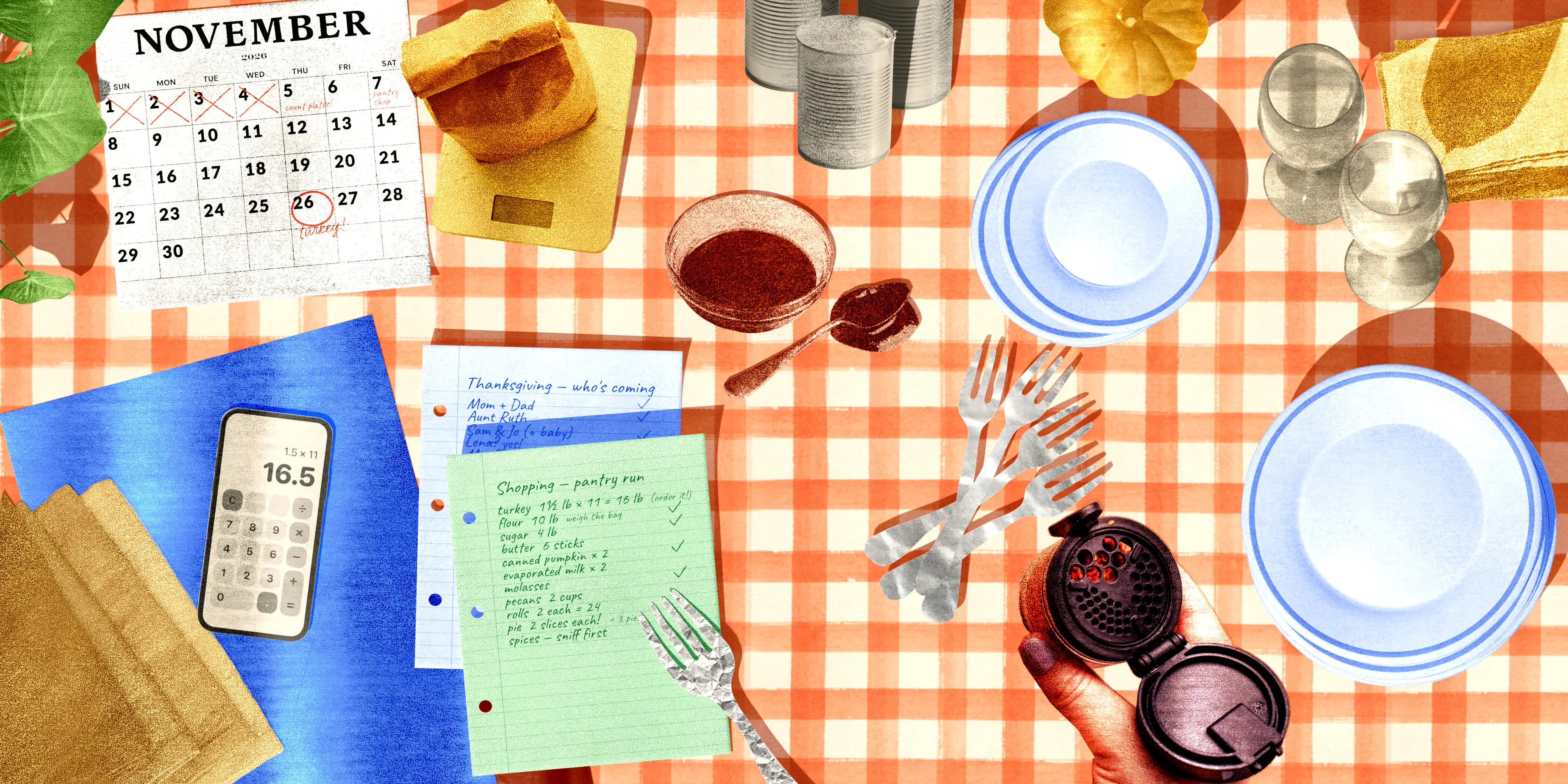
Thanksgiving is three weeks away. If you are hosting the turkey dinner this year, you may be slightly stressed, but there is no reason to freak out. Three weeks is plenty of time to get everything in order.
If you’ve already done everything I suggested in last week’s installment, you’re in great shape. If not, go ahead and complete those tasks. All done? Great. Here’s a quick overview of what I hope to accomplish three weeks before Thanksgiving:
- Count servingware, plates, dishes, linens, napkins, and glassware
- Calculate how much food will need be needed
- Make shopping list, including pantry staples
- Do some light shopping for non-perishables
Be sure you have enough plates and forks!

Consult your spreadsheet and count up how many place settings, wine glasses, water glasses, serving dishes, and serving spoons you will need, as well as how much flatware. Don’t forget about dessert plates, pie servers and coffee cups. If you are planning to brine your turkey, make sure you have a brining bag, or a food-safe container that is big enough to accommodate a turkey. If you are dry brining—and we recommend that you do—make sure you have the necessary wire rack and sheet pan.
If you are the type to use cloth napkins and placemats, be sure you have enough of those, too, and take a moment to track down your table linens. Give it all a wash, if needed.
Calculate how much food you will need

I have never run out of food on Thanksgiving, though I did have a close call with the Milk Street Butter-Braised Mashed Potatoes last year. Here are some rough ratios to ensure everyone gets plenty of turkey and fixin’s (with leftovers to spare):
- Turkey: For the big bird, 1 1/2 pounds per person is standard. This will leave you with some light leftovers, so if you want to send everyone home with enough to make a few sandwiches, increase to 2 pounds per person. (Especially if you are buying a bird that is 12 pounds or lighter, as the bone-to-meat ratio skews toward bone.)
- Mashed Potatoes: If you are working from a recipe, simply use the serving size to calculate how much you need. For example, this recipe makes 6-8 servings, but this is a big day for eating, so assume it will serve six people and go from there. If you’re winging it, or working from a recipe that doesn’t list the number of servings, assume you will need 1/2 pound of potatoes per person—that’s the weight of just the spuds, not the overall mash.
- Stuffing or Dressing: A lot of guides recommend 3/4 cup of stuffing or dressing per person, but most recipes do not list their yield by cups. Again, if you’re working with a recipe that lists number of servings, all you need to do is scale up or down according to that number. But if you are working with less explicit instructions, know that you’ll need about 1/4 pound of bread (pre-drying or staling) per person .
- Rolls: Don’t be stingy; provide 2 rolls per person (one for eating with dinner, one for wiping the plate with).
- Gravy and Cranberry Sauce: 1/3 cup per person works for each of these.
- Pie: Let’s be real: No one is going to eat just one slice of pie. Factor in 2 slices per person.
- Everything else: I consider other sides, like salads, vegetable casseroles and gratins to be bonus plate fillers, but you should aim for at least 1/3 cup per person for each.
Make a shopping list and take inventory
Make a list of every single ingredient you will need, including pantry staples, and write down how much you will need of each ingredient. Then, compare it against your existing inventory. Crucially: Don’t forget the spices. Open them up and give them a sniff. If they don’t smell like anything, they won’t taste like anything, either.
If you’re unsure if you have enough of a particular ingredient, like sugar, write how much sugar you’ll need for each recipe and add it all up. Then, weigh whatever partially-full bags and boxes you have. A conversion chart can help you convert from mass to volume (and vice versa)—a useful service, since some recipes only list one or the other. Lucky for you, I have taken the liberty of compiling just such a chart. (Please keep in mind these conversions are approximate, and may vary from brand to brand.)
All-purpose flour: 1 cup = 130 grams = 4.6 ounces
Bread flour: 1 cup = 137 grams = 4.8 ounces
Cake flour: 1 cup = 120 grams = 4.2 ounces
Almond flour: 1 cup = 100 grams = 3.5 ounces
Cornstarch: 1 cup = 132 grams = 4.7 ounces
Panko breadcrumbs: 1 cup = 60 grams = 2.1 ounces
Plain fine breadcrumbs: 1 cup = 164 grams = 5.8 ounces
White sugar: 1 cup = 214 grams = 7.5 ounces
Dark or light brown sugar (lightly packed): 1 cup = 199 grams = 7 ounces
Powdered sugar: 1 cup = 124 grams = 4.4 ounces
Butter: 1 cup = 16 tablespoons = 2 sticks = 227 grams = 8 ounces
Pecans, whole or chopped: 1 cup = 114 grams = 4 ounces
Molasses: 1 cup = 334 grams = 11.8 ounces
Honey: 1 cup = 334 grams = 11.8 ounces
Do some light shopping
Now is a good time to get the nonperishables, such as flour, sugar, butter (which is lightly perishable) and anything canned. It makes the week of Turkey Day a little more manageable, and lets you split the cost between two paychecks, instead of doing one unwieldy trip.
Join the conversation on Facebook, Instagram, TikTok and Pinterest.
And if you're looking for more Milk Street, check out our livestream cooking classes with our favorite chefs, home cooks and friends for global recipes, cooking methods and more.

Claire Lower
Claire Lower is the Digital Editor for Christopher Kimball’s Milk Street, with over a decade of experience as a food writer and recipe developer. Claire began writing about food (and drinks) during the blogging boom in the late 2000s, eventually leaving her job as a lab technician to pursue writing full-time. After freelancing for publications such as Serious Eats, Yahoo Food, xoJane and Cherry Bombe Magazine, she eventually landed at Lifehacker, where she served as the Senior Food Editor for nearly eight years. Claire lives in Portland, Oregon with a very friendly dog and very mean cat. When not in the kitchen (or at her laptop), you can find her deadlifting at the gym, fly fishing or trying to master figure drawing at her local art studio.

