
Chocolate Mousse, Again?
Yup. During a visit to Le Bon Georges on Rue Saint-Georges in Paris, I encountered a chocolate mousse that was so light that one serving was the size of a fanny pack.

Extra egg whites, not overwhipped—and no cream—are the secret to a light-as-air Parisian chocolate mousse.

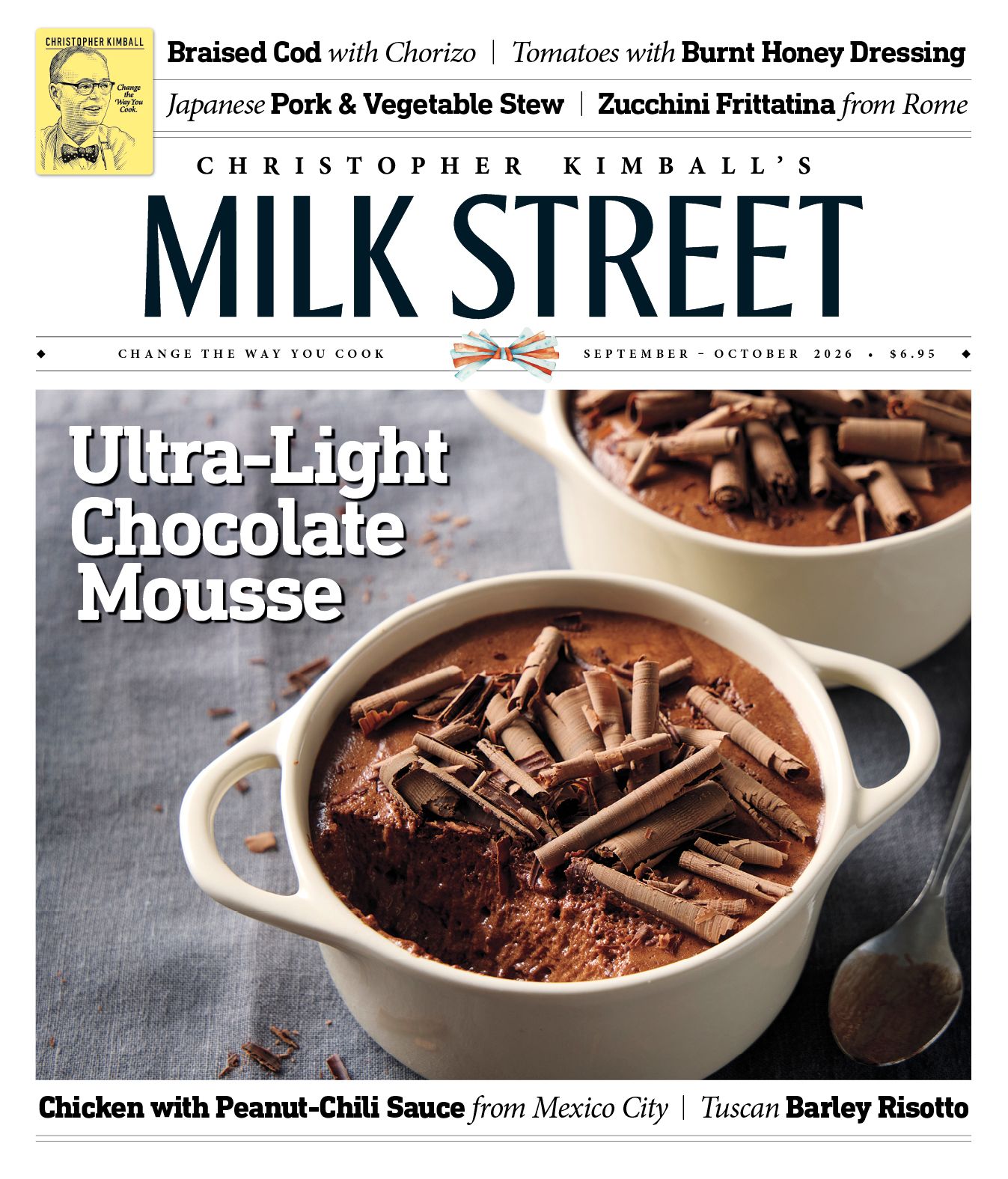
When I founded Milk Street ten years ago, my vision included a slew of new recipes (new to me) from around the globe with big flavors, bold ingredients, and new techniques. This was, in large part, true. What I did not contemplate was the captivating mysteries of variations on the classics. From Paris alone, we have been charmed by updated recipes for French onion soup, baked-to-order madeleines, rice pudding, tarte tatin, salade nicoise, and, most recently, chocolate mousse. Just like visiting the renovated Notre Dame!
Although the French restaurant is an endangered species here in the states (although there are rumors, faint stirrings, of a comeback), when I walked into Le Bon Georges in Paris last September, I was immediately struck with an emotional hotshot, a blast of reverence for the French bistro. It’s 8AM, chairs are upside down on tables, we are greeted with the usual “Comment ça va?” and a small cup of decent espresso as we sit at the bar. A mechanical street sweeper slowly brushes by and the ancient brigade system starts to rise up for yet another day. You know that this day is going to be a good one because the French have been doing this so long it is in their blood—it’s Gallic muscle memory tethered to a passion for professional service. The only thing missing is a cigarette dangling from the corner of a mouth and a bit of local slang as in bouffe instead of eat.
But back to the mousse. Chef Loïc Lobet is central casting. Chef whites with a classic French blue apron and no toque, his smile reminded me a tad of Jean-Paul Belmondo—wry, appealing and clearly ironic although Lobet is more James Mason than Belmondo. (His pastry chef, however, presented himself with a starched toque so high that I felt like I was at Le Cordon Bleu.) The problem with many chocolate mousse recipes is that they are only slightly lighter than chocolate pudding and not much tastier. When Chef Lobet showed me the not-very-small Staub cocotte that made up one serving, I was shocked. It was a challenge of sorts—more than a normal human could consume at one sitting but, I was told, many customers finished off the cocotte solo, heads down, with great relish.
This of course meant that this chocolate mousse had to be ethereal, seraphic, heavenly. And it was. The recipe was simple enough—chocolate, butter, egg yolks and salt are put into a bowl with hot half-and-half and whisked til the chocolate melts. Five egg whites (the recipe calls for only two yolks) are whipped with light brown sugar (two tablespoons) with a bit of cream of tartar to produce a more stable, creamier result. The whites are folded into the base—the mixture will appear a bit soupy at this point—and then refrigerated for at least four hours.
The secret to this recipe is that the classic chocolate mousse uses three yolks and three whites—here the whites vastly outnumber the yolks. Second, whipped cream, is not folded into the mixture—the whites do all of the heavy lifting. Finally, the amount of dairy is lower—just three quarters cup instead of a cup or more.
So if you think that chocolate mousse is either child’s play or too much of a good thing, I recommend Chef Lobet’s version. But please do not offer piddly ramekin-size servings. This dessert is designed to be a challenge, not a mere soupçon of sweet.

Chris Kimball
Christopher Kimball is founder of Milk Street, which produces Milk Street Magazine, Milk Street Television on PBS, and the weekly public radio show Milk Street Radio. He founded Cook’s Magazine in 1980 and was host and executive producer of America’s Test Kitchen until 2016. Kimball is the author of several books, including "The Yellow Farmhouse" and "Fannie’s Last Supper."

