
Arianna Pasquini Keeps It Simple
During the week, it’s mostly pasta, eggs and vegetables with fresh fruit for dessert



Arianna Pasquini is demonstrative and engaging, almost every sentence starting with “Allora!” I was not surprised that she had been an actor; her face is that animated. During the trip I asked her about what she cooked weeknights and it turned out that what she cooks at home is quite different from the pasta and pizza that are so often associated with Roman cooking.
True Romans tend to live outside of the city center and do their shopping near their home. There are more than 70 mercati rionali (local markets) in and around Rome, and Arianna shops at her local market three or four times per week. They might go into Rome, but only midweek with fewer tourists, and frequent Trastevere or some neighborhoods a bit off the beaten track. Most of the best restaurants do not take reservations; others require reservations weeks in advance to circumvent the tourist trade. For lunch, offices always offer a small break room with hot plates, a microwave and a good coffee machine. No coffee machine means you don’t take the job.
During the week, the aperitif is popular, a trend that started in the north. (Milano for Campari, Torino for Vermouth and Venezia for the spritz.) Romans are not big on cocktails; it’s red wine (Cesanese) in the winter, white (Passerina) in the summer, and Arianna makes it clear, “Never bubbles!” (Artisanal beers and natural wines are also having their moment.) Bars often serve breakfast and stay open late—some are just for drinking; others offer food as well. In the summer, the bar scene starts way past my bedtime and the newer ones might offer tapas-like items such as small tramezzini (triangle sandwiches with savory fillings). Roasted salted peanuts, giant green olives, taralli, or lupini (a yellowish bean) are common.
Junk food is rare. Instead, Romans will order pizza al taglio (slices), which come from very long (five or six feet long) thin pizzas topped with zucchini or other simple toppings. When I visited Forno Campo de’Fiore years back, I was charmed by the fact that Italians never walk and eat; everyone stood just outside the front door and ate their slice standing (and talking).
Arianna’s advice for tourists is do not book restaurants in advance. Just get lost in Rome, stay away from the social media spots—and the small places that do not look good (as if there were a mouse or two in the kitchen) are the best places to experience the true Rome. And you can skip crowded museums; there are at least 1,000 churches in Rome and some have Caravaggios and other famous Italian painters.
As for cooking, most Romans use dried pasta (fresh pasta is more common in the cooler northern regions). For risotto, she uses a short, fat rice from Veneto called vialone nano. (She says that carnaroli is very hard and requires a lot of stirring.) The rice is roasted in the soffritto made with onion, butter, EVOO and salt and then she adds the wine and then starts with the broth, just enough to cover the rice. She covers and cooks the rice over a low fire and repeats the process twice.
Arianna studied at the Gambero Rosso Academy and then gained experience in Michelin-starred restaurants in Rome. She continued experimenting with new cuisines while working abroad as a chef. She also runs food tours and gives private cooking lessons to small groups.
Here is Arianna and her recipes.
Weeknights in Rome
At 35, I live alone for the first time in a small apartment with a terrace. I often eat with my neighbor Alessandro and his partner Giancarlo, who is a general practitioner in a small seaside town outside Rome. He always has wonderful vegetables and fresh eggs brought to him by the farmers he looks after, and I cook them.
For me, the base of quick midweek meals is pasta and vegetables. My pantry always contains both fresh and stale bread (I soak the latter in water and eat with tomatoes for breakfast). I also keep pasta, tomato passata and canned tomatoes and, of course, coffee for my Bialetti moka, “00” flour, extra-virgin olive oil and a bottle of wine, mainly a light-bodied red. In the fridge: eggs, vegetables and Parmigiano-Reggiano. On the balcony: a couple of herb plants. Meat, butter, and fish are rare in my house. I love risotto (not a Roman dish of course), especially in winter whenever I have more time. Guanciale, prosciutto and pecorino Romano are used only occasionally since they are expensive.
Midweek suppers are simple: two courses and maybe a vegetable side. There may be a small antipasto of salumi and cheese, then either a pasta or a soup (more rarely rice), or a secondo (meat or fish), plus a contorno. Fried snacks, sodas, elaborate desserts, risotto, polenta, pizza, and long-preparation dishes are usually avoided weekdays. What never disappears from the table is bread, water, and wine. At the end of the meal, almost everyone eats a piece of fruit. Espresso after dinner is a divisive matter: some believe it helps digestion, others think it keeps you awake.

Chris Kimball
Christopher Kimball is founder of Milk Street, which produces Milk Street Magazine, Milk Street Television on PBS, and the weekly public radio show Milk Street Radio. He founded Cook’s Magazine in 1980 and was host and executive producer of America’s Test Kitchen until 2016. Kimball is the author of several books, including "The Yellow Farmhouse" and "Fannie’s Last Supper."
Arianna Pasquini
(antipasto or vegetarian secondo)
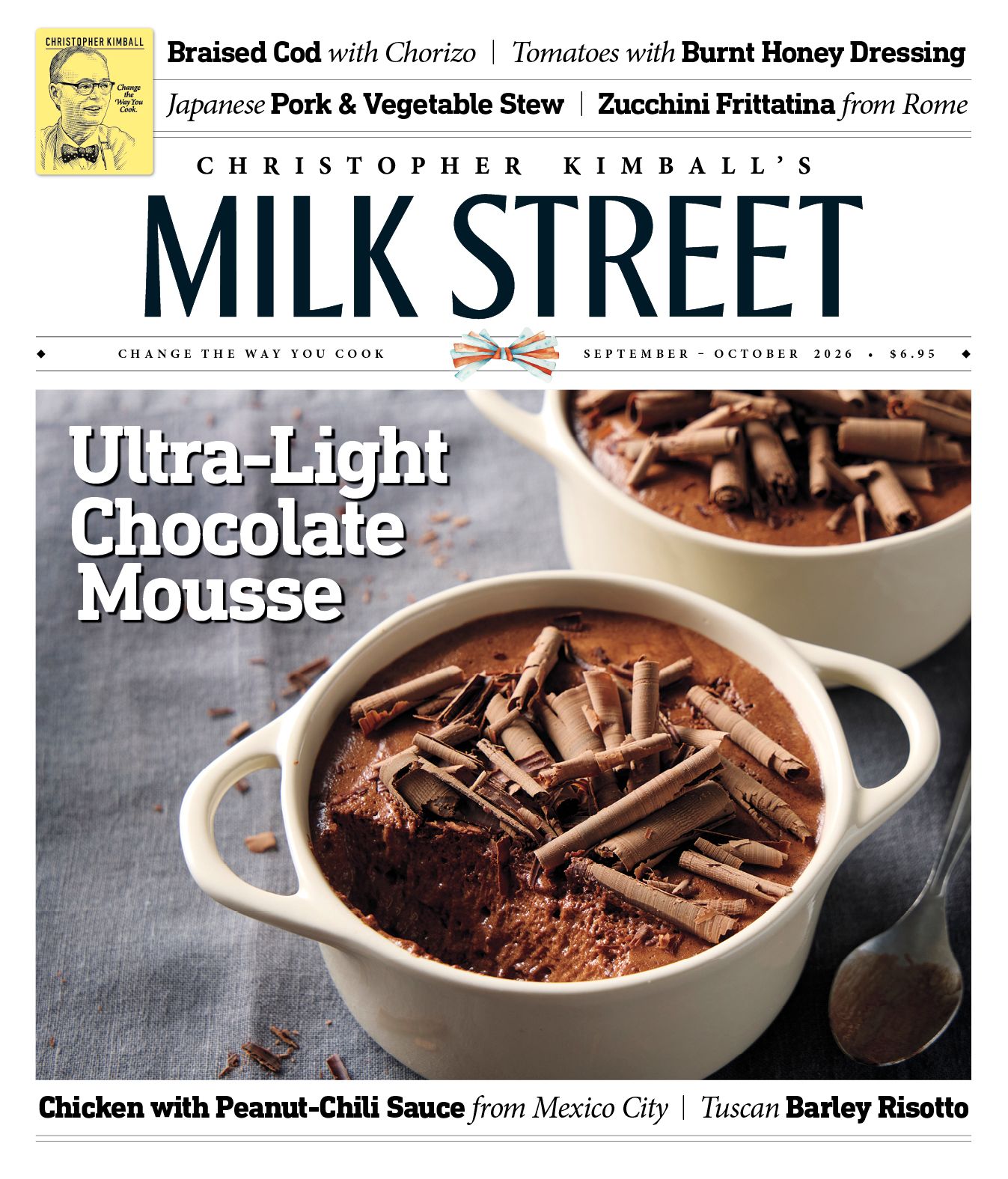
Zucchini Frittatina

My neighbor, Alessandro, is a psychologist. He has a cat named Orfeo and a theory for everything. This is one: you can tell “primavera” is coming when the landing smells like “frittatina di zucchine.” I make Zucchini Frittatina in the late spring when the first young Roman zucchini of the season, with their blossoms, show up in the markets like a fashion show. The frittata, like meatballs, is made all over Italy and keeps well for a couple of days if properly cooked. We eat it for breakfast, in sandwiches, packed for the beach, as a pasta dish with leftover pasta inside, at picnics (it can be served at any temperature), as a starter or main, or cut into cubes for aperitivo. It is the queen of versatile and delicious food.
(secondo)
Beef Straccetti with Arugula

This dish was often served by Donna Fiore, otherwise known as Fiorella, from Trastevere. She was one of the few people I met in my life who was still speaking Roman dialect, not just the slang. My friends and I were crazy teenagers and returned to Donna Fiore’s well after midnight and this is one of the recipes she served us for a late breakfast. Straccetti (literally, “little torn strips”) must be cooked and eaten immediately as they are very thin. To properly cook the beef, you need a very hot pan, garlic and olive oil. It should cook for just two or three minutes, and only at the end get a splash of balsamic or apple cider vinegar.
Polpette in Umido

As far as I know, there is at least one version of meatballs in every region of Italy. As you move farther north, tomato tends to disappear and is replaced by other kinds of sauces. A wonderful example is “canederli” from South Tyrol, on the border with Austria, served in broth or with cheese and made almost entirely of bread, only sometimes containing speck. In Rome, meatballs tend to be “white.” This “in umido” recipe of my father’s is his own, more bread-heavy and therefore softer version of the original mixture made by his mother, my grandmother Maria, which was richer in meat. Meatballs have the advantage of being assembled in advance, kept raw in the fridge, and cooked the next day. Flattened, they can be added to pasta sauces or enriched with a cheesy center (like “provola” or “fior di latte”), or with raisins and pine nuts, as is common in southern Italy where sweet-and-sour flavors prevail.

